Beef rib joint, allow 225-350g / 8-12 oz per person
Weigh joint and calculate cooking times thus:
— rare - 20 min. per 450g / 1lb + 20 min. (e.g. 3lbs.
= 80 minutes),
— medium - 25 min. per 450g / 1lb + 25 min.,
— well-done - 30 min. per 450g / 1lb + 30 minutes.
Start with the roast at room temperature (remove from
refrigerator 1-2 hours before cooking - keep it wrapped). Pre-heat oven
to 375°F / 190°C.
Place in rack in roasting pan and roast in pre-heated
oven for the calculated time less 30 minutes.
Meanwhile place all other ingredients for the glaze
in a saucepan, bring to boil, simmer and reduce for approx. 5 minutes,
stirring occasionally.
Remove joint from oven and brush glaze onto all surfaces.
Return to oven for 30 min. basting with remaining glaze. Stand joint
for 10 min. before carving.
For The Glaze:
1/4 pint / 5oz. / 1.5 dl red wine
4 tablespoons hot horseradish |
1 tablespoon clear honey
1 tablespoon Tabasco sauce |
Rump Roast Beef
We typically use a rump roast when making roast beef. You can also
use a round roast or a sirloin tip with these instructions. This slow
roasting method at low heat is good for tougher cuts of beef; the lower
heat prevents any gristle from getting too tough. This method should
NOT be used with choice or prime grades of beef, or the more tender
cuts, as slow cooking more delicate cuts will make them mushy.
Roast beef made this way is easy, relatively inexpensive, and you
get great leftovers for roast beef sandwiches.
3 to 3.5 lbs / 1.3 to 1.6 kg of Boneless Rump Roast
(pick an end cut with a lot of fat marbling)
Olive oil
8 slivers of garlic
Salt and pepper
You will need a meat thermometer
For the gravy:
Red wine, water, and or beef stock
corn starch
Start with the roast at room temperature (remove from refrigerator
1-2 hours before cooking - keep it wrapped). Preheat the oven to 375°F
/ 190°C.
With a sharp knife make 8 small incisions around the roast. Place
a sliver of garlic into each incision. Take a tablespoon or so of olive
oil and spread all around the roast. Sprinkle around the roast with
salt and pepper. Place the roast directly on an oven rack, fatty side
up, with a drip pan on a rack beneath the roasting rack. This arrangement
creates convection in the oven so that you do not need to turn the roast.
The roast is placed fat side up so that as the fat melts it will bathe
the entire roast in its juices.
Brown the roast at 375°F / 190°C for half an hour. Lower the heat
to 225°F / 110°C. The roast should take somewhere from 2 to 3 hours
additionally to cook. When the roast just starts to drip its juices
and it is brown on the outside, check the temperature with a meat thermometer.
Pull the roast from the oven when the inside temperature of the roast
is 135° / 60°C to 140°F / 65°C. Let the roast sit for at least 15 minutes
before carving to serve.
To make the gravy:
Remove the dripping pan from the oven and place on the stove top at
medium heat. Note that if you are pulling the roast out early, for rare
or a medium rare level of doneness, you may not have a lot of drippings.
Hopefully you will have some. If not, you may want to leave the roast
in a little longer at even lower heat, 175°F / 80°C, to ease some more
drippings out of it. Add some water, red wine, or beef stock to the
drippings to deglaze (loosen the drippings from the pan). Dissolve a
tablespoon of cornstarch in a little water and add to the drip pan.
Stir quickly while the gravy thickens to avoid lumping. You can add
a little butter if there is not a lot of fat in the drippings. Add salt
and pepper to taste. Add some fresh thyme too if you have some.
(from
Simply Recipes, a great recipe resource...)
|
Prime Rib Roast Beef
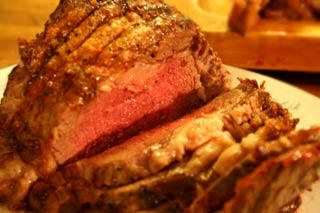
Make sure to buy the prime rib roast properly tied and ready to put
in the oven. The rib bones should actually be cut first, away from the
roast, and then tied back on the roast with kitchen string before roasting.
The butcher where you buy your roast should do this for you. Estimate
2 people served for every rib, that is, allow 225-350g / 8-12 oz per
person.
Note that true prime refers to the quality
of the meat (i.e. Select, Choice, Prime), and must usually be ordered
from a good butcher well in advance of when it will be needed. In recent
years many sellers have taken to use the term "prime rib" for the roast,
regardless of the quality. If you want the high quality prime rib, make
sure that is what you are getting from your butcher - look for the Prime
stamp.
1 Remove roast from the refrigerator a couple hours before
cooking. Roasts should always be brought to room temperature first,
before they go in the oven.
Cookbooks often call for the excess fat to be removed. By "excess"
fat they mean any fat more than an inch thick. The fat is what provides
the flavor and what you are paying for with prime rib, so you want to
leave it on. Your butcher should have removed any excess fat.
2 Preheat your oven to 500°F / 250°C,
or the highest it will go. Salt and pepper the natural fat covering
the roast.
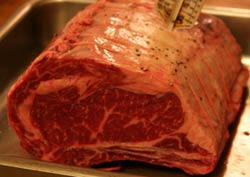
3 Insert a meat thermometer into the thickest part of the
roast, making sure it doesn't touch a bone. (Most meat thermometers
require that you poke a hole first with a skewer, and then insert the
thermometer.) Place the roast, fat side up, rib side down in a roasting
pan in the oven.
4 After 15 minutes on 500°F / 250°C, reduce the heat to 350°F
/ 175°C. To figure out the total cooking time, allow 15 minutes per
pound for rare and 20 minutes per pound for medium rare, or 25 minutes
per pound for well done. Roast in oven until thermometer registers 120°F
/ 50°C for rare or 135°F / 60°C for medium. Remove from oven and let
rest 15 minutes before carving. The roast continues to cook while it
is resting.
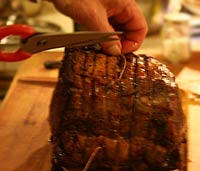
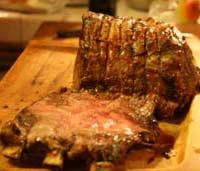
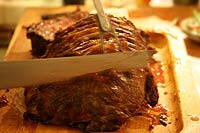
5 With a knife, cut the strings which attach the meat to the
bones. Remove the bones (save for making stock for
soup. Then, using a sharp carving knife, slice meat across the grain
for serving, making the slices about 1/4-inch / .5cm thick.
Making gravy
To make the gravy, remove the roast from the pan. Place pan on stove
on medium high heat. Pour off all but 2 tablespoons of the drippings
to a separate container. Into the 2 tablespoons of drippings in the
pan stir in 1 to 2 tablespoons of flour. Stir with a wire whisk until
the flour has thickened and the gravy is smooth. Continue to cook slowly
and stir constantly. Slowly add back the previously removed drippings
(remove some of the fat beforehand if there is a lot of fat). In addition
add either water, milk, stock, cream or beer to the gravy, enough to
make 1 cup. Season the gravy with salt and pepper and herbs.
(from
Simply Recipes, a great recipe resource...)
|

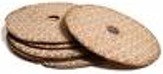 Having
his taste buds set on pizza, and necessity being the mother of invention,
he ransacked the kitchen cupboards and found a package of those large
round (11 inch / 28cm) Swedish knäckebröd – the crispbread with the
hole in the middle – as well as a jar of capers and olives. The refrigerator
yielded a tomato, an onion, some ham, and a half-empty jar of spaghetti
sauce. With the addition of a few herbs and garlic, presto, was born
the Swedish Pizza – fusion food created in Sweden by
a Canadian who'd lived 4 years in New York, and 16 years in Britain and recently moved to the
south of France...
Having
his taste buds set on pizza, and necessity being the mother of invention,
he ransacked the kitchen cupboards and found a package of those large
round (11 inch / 28cm) Swedish knäckebröd – the crispbread with the
hole in the middle – as well as a jar of capers and olives. The refrigerator
yielded a tomato, an onion, some ham, and a half-empty jar of spaghetti
sauce. With the addition of a few herbs and garlic, presto, was born
the Swedish Pizza – fusion food created in Sweden by
a Canadian who'd lived 4 years in New York, and 16 years in Britain and recently moved to the
south of France...  By
the time it cooks under the grill the crisp crust has softened a bit
and is neither crunchy nor soggy, in fact, remarkably like a "real"
pizza. You end up with a super tasty thin-crust pizza that is easy to
slice up with a pizza wheel or a knife. You can eat it with your fingers
or a knife and fork. If you don't live in Scandinavia, you can
buy the Käckebröd Råg (rye crispbread) at Ikea or a specialty store in packs
of 5 or more rounds. For the 'piza' sauce, I usually use a cheap canned
pasta sauce (roasted garlic and herbs) since it has more flavour than
tomato paste. The sauce does not need to be gourmet sauce since it will
be dominated by the other ingredients.
By
the time it cooks under the grill the crisp crust has softened a bit
and is neither crunchy nor soggy, in fact, remarkably like a "real"
pizza. You end up with a super tasty thin-crust pizza that is easy to
slice up with a pizza wheel or a knife. You can eat it with your fingers
or a knife and fork. If you don't live in Scandinavia, you can
buy the Käckebröd Råg (rye crispbread) at Ikea or a specialty store in packs
of 5 or more rounds. For the 'piza' sauce, I usually use a cheap canned
pasta sauce (roasted garlic and herbs) since it has more flavour than
tomato paste. The sauce does not need to be gourmet sauce since it will
be dominated by the other ingredients.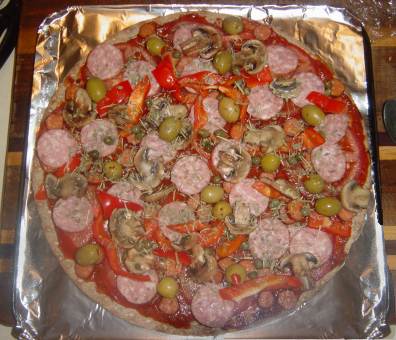
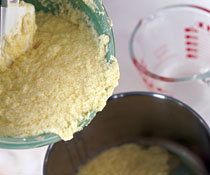 In
a large bowl, beat the butter and sugar with an electric mixer, about
2 min. Slowly add the eggs and yolks. Beat for 1 minute (this will keep
the mixture from being lumpy during cooking). Mix in the lemon juice.
The mixture will look curdled, but it will smooth out as it cooks.
In
a large bowl, beat the butter and sugar with an electric mixer, about
2 min. Slowly add the eggs and yolks. Beat for 1 minute (this will keep
the mixture from being lumpy during cooking). Mix in the lemon juice.
The mixture will look curdled, but it will smooth out as it cooks.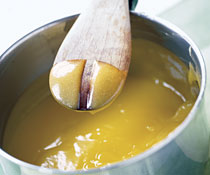 In
a medium, heavy-based saucepan, cook the mixture over low heat until
it looks smooth. (The curdled appearance disappears as the butter in
the mixture melts.) Increase the heat to medium and cook, stirring constantly,
until the mixture thickens, about 15 min. It should leave a path on
the back of a spoon and will read 170°F on a thermometer. Don't let
the mixture boil.
In
a medium, heavy-based saucepan, cook the mixture over low heat until
it looks smooth. (The curdled appearance disappears as the butter in
the mixture melts.) Increase the heat to medium and cook, stirring constantly,
until the mixture thickens, about 15 min. It should leave a path on
the back of a spoon and will read 170°F on a thermometer. Don't let
the mixture boil.